
Clean Room
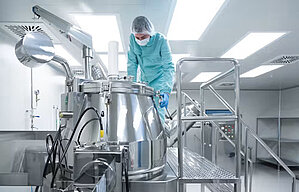
Electropolishing ensures:
- a reduction in free dust and metal particles: the release of metallic microparticles (flaking of micro-burrs measuring 0.1–0.3 µm) is prevented.
- Smooth and flake-free surfaces: the removal of micro-burrs significantly reduces the number of attachment points for microfibres.
- A dust-free surface that can be thoroughly cleaned very easily
Indispensable in the production of semiconductors, as well as in the silicon and microelectronics industries.
Virtually standard practice in the pharmaceutical industry.
Recommended treatments: electrolytic polishing or micro-undulation
Vacuum & Autoclave
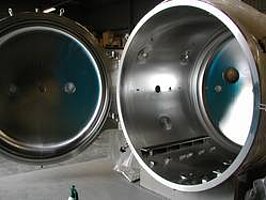
Electropolished surfaces exhibit significantly lower desorption and outgassing rates under high vacuum. During electropolishing, the metal surface is selectively oxidised, which also effectively removes hydrogen residues. Micro-deburring reduces the three-dimensional surface area by up to 80%. Furthermore, the material is thoroughly cleaned of grease residues and coated with a dense, impermeable layer of chromium oxide.
The result of electrolytic polishing is a perfectly sealed and smooth surface, completely free of porosity. Thanks to these degassed stainless steel walls, the pumping times required to create a stable vacuum in the chamber are reduced by a factor of 10, resulting in a significantly better and more stable vacuum quality.
Thanks to these superior surface properties, subsequent autoclave processes are also even easier to control.